WesBank pivots offerings to accommodate shifting mobility trends

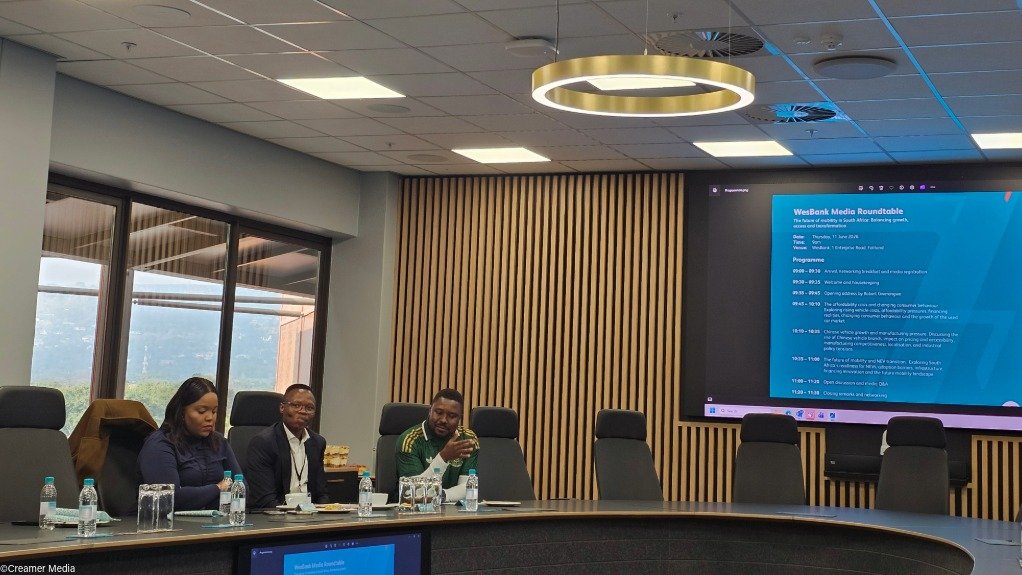
FNB Commercial Lend Pillar product head Linda Musonda, WesBank and FNB senior economist Thanda Sithole and WesBank CEO Robert Gwerengwe at the roundtable
Photo by Creamer Media's Tasneem Bulbulia


As automotive consumers in South Africa contend with affordability pressures, Chinese vehicle brands gain prominence and the shift to new-energy vehicles (NEVs) and future mobility solutions unfolds, leasing asset-based finance provider WesBank is responding by adapting its offering to both accommodate and shape this evolving landscape.
This was outlined by the company at a media roundtable: 'The future of mobility in South Africa: Balancing growth, access and transformation', held at its offices, in Johannesburg, on June 11.
WesBank CEO Robert Gwerengwe highlighted that the company’s approach was to be involved in the entire value chain, compared to its traditional model of providing financing options.
“We need to take the angst out for customers, and we have the ability. Through our original equipment manufacturer (OEM) relationships we should be, and we will be, going deeper into charging stations, across the board, building the infrastructure, being part of that – that’s work that’s happening already,” he acclaimed.
WesBank is also exploring rolling out different incentives, such as value proposition for customers to charge at certain stations for free for a certain period of time, and charging as a service.
“We can’t play a similar role to what we’ve done on internal combustion engine (ICE) vehicles – it has to be completely different. That’s actually what’s exciting for us, because I think we can make a marked difference to the economy here by being involved in the full value chain,” Gwerengwe emphasised.
Moreover, with the transition to NEVs being largely policy-driven in international markets, Gwerengwe told Engineering News that WesBank was engaging with government on legislative issues, with the frequency of this increasing as clarity emerged on how the landscape should look.
Gwerengwe pointed out that rising fuel prices on the back of global conflicts and macroeconomic factors presented an opportunity to sell more NEVs and the like, with this currently only constituting a small percentage of vehicle sales in South Africa.
He predicted a “massive opportunity” for the country if it undertook this correctly.
FNB Commercial Lend Pillar product head Linda Musonda stressed the need for a coordinated effort to drive large-scale investment in, and adoption of, NEVs. WesBank is a division of FNB.
She highlighted that WesBank had seen a greater interest in these from customers recently, with searches and queries surging in the first quarter.
“There’s definitely more interest, with customers trying to understand how they can secure an NEV. From a commercial perspective, we see that interest translates into targeted approaches,” Musonda explained.
She acclaimed that it was “encouraging” that fleet customers, in particular, were engaging in pilots, as the international electrification journey was largely fleet operator-led.
This was because the use case for fleet electrification was strong, with Musonda highlighting economic gains for customers who had piloted for the correct portion of their fleet.
WesBank was also assisting customers with calculating the portion of their fleet that should be electrified, as this was not a one-size-fits-all approach, she informed. It was also analysing how to leverage public infrastructure, and assessing whether this was sufficient to support the electrified vehicles and their routes.
Moreover, she averred that WesBank’s solutions were also well positioned to support customers looking to transition their personal vehicle to an NEV.
“We buy the assets, we manage the assets, we dispose of the assets, so we manage that full value chain . . . The risks around residual values, the uncertainty around how to manage that vehicle, we take it away from customers, and that’s some of the work that we’re doing now,” Musonda said.
Gwerengwe also outlined WestBank’s strategy to be more relevant, with its current model stretched, and the company looking to be more inclusive and offer a mobility solution to people in underserved areas.
It will leverage lessons from other African countries as it explores how to innovate in asset finance and mobility.
MOBILITY TRENDS
In terms of affordability, Gwerengwe pointed out that customers were under pressure at the moment. This was reflected in the company’s figures from the last month, which revealed a “wait and see” approach from customers, who were registering interest but not following through.
“For us at WesBank, our goal is to make our solutions as affordable as possible to customers, and have conversations with customers about putting them into solutions that make the most sense from an affordability perspective for them,” he highlighted.
Gwerengwe informed that the company was pushing hybrids and EVs, offering a “strong value proposition” for customers for these.
Gwerengwe also outlined a shifting trend in the country away from legacy brand loyalty, with many customers now opting for Chinese brands. Reasons for this included these offering a more cost-competitive option with warranties, among others, to address the affordability issue facing consumers, who were now becoming more concerned with the total cost of ownership, he pointed out.
Moreover, these vehicles boasted technology features that customers desired and that were typically associated with premium brands, WesBank and First National Bank (FNB) senior economist Thanda Sithole said.
Further, Chinese brands were knowledgeable about their customer base and had invested strategically in marketing their proposition, both globally and in South Africa. Trust in these brands was also increasing, he added.
Consumers can benefit from lower costs and a wider range of options, and this increased competition could force local manufacturers to offer more cost-competitive prices.
However, it did place a strain on the latter, who were largely export-driven, Sithole explained.
Therefore, there was a need for balance, with local consumers wanting affordability, government backing export-driven domestic production, and OEMs needing to position themselves for global competitiveness in a transitioning market, he emphasised.
Other considerations mentioned included the need for more Chinese brands to increase their manufacturing base in the country, and how this would impact on the domestic supply value chain, depending on their level of localisation.
Moreover, while legacy brands have played a role in building the country’s NEVs infrastructure, there is a need for Chinese brands to also contribute to this, rather than just providing the vehicles.
Article Enquiry
Email Article
Save Article
Feedback
To advertise email advertising@creamermedia.co.za or click here
Research Reports
Projects

Latest Multimedia


Showroom
For over 60 years, VEGA has provided industry-leading products for the measurement of level, density, weight and pressure. As the inventor of the...
VISIT SHOWROOM
Stewarts & Lloyds is a leading steel, tube, and engineering product supplier in South Africa.
VISIT SHOWROOM

Press Office
Announcements
What's On
Subscribe to improve your user experience...
Option 1 (equivalent of R125 a month):
Receive a weekly copy of Creamer Media's Engineering News & Mining Weekly magazine
(print copy for those in South Africa and e-magazine for those outside of South Africa)
Receive daily email newsletters
Access to full search results
Access archive of magazine back copies
Access to Projects in Progress
Access to ONE Research Report of your choice in PDF format
Option 2 (equivalent of R375 a month):
All benefits from Option 1
PLUS
Access to Creamer Media's Research Channel Africa for ALL Research Reports, in PDF format, on various industrial and mining sectors
including Electricity; Water; Energy Transition; Hydrogen; Roads, Rail and Ports; Coal; Gold; Platinum; Battery Metals; etc.
Already a subscriber?
Forgotten your password?
Receive weekly copy of Creamer Media's Engineering News & Mining Weekly magazine (print copy for those in South Africa and e-magazine for those outside of South Africa)
➕
Recieve daily email newsletters
➕
Access to full search results
➕
Access archive of magazine back copies
➕
Access to Projects in Progress
➕
Access to ONE Research Report of your choice in PDF format
RESEARCH CHANNEL AFRICA
R4500 (equivalent of R375 a month)
SUBSCRIBEAll benefits from Option 1
➕
Access to Creamer Media's Research Channel Africa for ALL Research Reports on various industrial and mining sectors, in PDF format, including on:
Electricity
➕
Water
➕
Energy Transition
➕
Hydrogen
➕
Roads, Rail and Ports
➕
Coal
➕
Gold
➕
Platinum
➕
Battery Metals
➕
etc.
Receive all benefits from Option 1 or Option 2 delivered to numerous people at your company
➕
Multiple User names and Passwords for simultaneous log-ins
➕
Intranet integration access to all in your organisation